
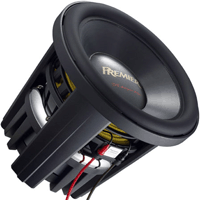
If you want the deepest, most physical low end a car can produce and you have the trunk space and amplifier to feed it, a 15 inch subwoofer is the answer. This guide covers the best 15 inch car subwoofers for 2026, how they compare on power and impedance, what enclosure and amp each one needs, and whether a 15 is actually the right move over a 12.
This is written the way you would explain it to someone standing in the shop, not the way a spec sheet reads, and it draws on manufacturer specifications, independent tests and owner reports. No hype, no “loudest ever” claims. Just what these drivers do, who they suit, and where the trade-offs land.
Best 15 Inch Subwoofers at a Glance
Below is a side-by-side comparison of eight 15 inch subwoofers that are worth your attention in 2026. They span budget daily-driver drivers up to competition-leaning SPL woofers. Power figures are the manufacturer RMS continuous ratings. Where a spec is a series-level or estimated figure rather than a confirmed model number, I have flagged it so you know not to treat it as gospel.
| Model | RMS Power | Impedance Options | Best For | Verdict |
|---|---|---|---|---|
| Skar Audio SDR-15 | 600W | Dual 2 ohm, Dual 4 ohm | First-time 15 build on a budget | Most bass per dollar |
| Rockford Fosgate P3D4-15 | 600W | Dual 2 ohm, Dual 4 ohm | Musical daily driver | The reliable all-rounder |
| Kicker CompR 15 (CWR152) | 800W | Dual 2 ohm, Dual 4 ohm | Loud daily with clean output | Easy to wire, forgiving |
| JL Audio 15W3v3 | 500W (series rating) | Dual 4 ohm, Single 4 ohm | Sound quality over raw volume | Tight, accurate, refined |
| Skar Audio EVL-15 | 1250W | Dual 2 ohm, Dual 4 ohm | Serious daily SPL on a budget | Huge output for the price |
| Sundown Audio SA-15 v.3 | ~1000W (unconfirmed for v.3) | Dual 2 ohm, Dual 4 ohm | Compact-box SPL builds | Small box, big hit |
| Rockford Fosgate Punch P2D4-15 | 400W | Dual 4 ohm | Modest power, clean bass | Low-power friendly |
| Sundown Audio X-15 v.3 | 2500W (series rating) | Dual 1 ohm, Dual 2 ohm | Competition and burp SPL | Overkill for most cars |
Read the mini-reviews below before you buy. The right pick depends far more on your amplifier, your box, and how much trunk you are willing to give up than on which driver has the biggest number.
The Subwoofers, Reviewed
Skar Audio SDR-15
The SDR is where a lot of people start their first 15 inch build, and for good reason. At 600 watts RMS it does not demand a monster amp, the dual voice coil options make wiring flexible, and it moves a lot of air for what it costs. Owners and independent tests report that it plays clean up to sensible power and holds together in a ported box tuned around 32 to 35 Hz.
- Pros: Excellent output for the money, easy to power, forgiving in most enclosures.
- Cons: Not a sound-quality reference driver, cone control tightens up only with a well-braced box.
- Who it is for: Anyone building their first 15 who wants maximum impact without a big amplifier bill.
Rockford Fosgate P3D4-15
The Punch P3 is the driver I recommend most often to people who want one sub that does everything reasonably well. 600 watts RMS, dual 4 ohm (a dual 2 ohm version also exists), and a stamped-and-cast build that has been refined over many generations. It leans musical. Kick drums and bass lines stay defined rather than turning into one long low rumble.
- Pros: Balanced musical output, proven reliability, works in sealed or ported.
- Cons: Costs more than budget rivals at the same power, not the loudest option here.
- Who it is for: The daily driver who listens to a bit of everything and wants clean, defined bass.
Kicker CompR 15 (CWR152)
Kicker’s CompR sits a step above their entry Comp line and it is one of the easiest 15s to live with. Around 800 watts RMS, dual voice coil, and a high sensitivity that means it gets loud without an enormous amplifier. The injection-molded cone and thick surround take abuse well. If you want loud daily bass and do not want to fuss over enclosure tuning, this is a safe landing.
- Pros: High efficiency, gets loud on modest power, tolerant of box variation.
- Cons: Can get boomy in an oversized ported box, less refined than the JL W3.
- Who it is for: Someone who wants volume and simplicity over surgical accuracy.
JL Audio 15W3v3
If the goal is sound quality rather than shaking mirrors off the wall, the JL W3 is the driver on this list with the strongest record. Series RMS handling sits around 500 watts, which is modest by 15 inch standards, but that is the point. This is a controlled, accurate woofer that reproduces a bass guitar as a bass guitar. It rewards a properly built sealed enclosure and a clean amplifier.
- Pros: Excellent transient control, tight and musical, superb in a sealed box.
- Cons: Premium price, lower power handling means less headroom for SPL chasing.
- Who it is for: The listener who values accuracy and detail over maximum loudness.
Skar Audio EVL-15
The EVL is Skar’s step up from the SDR and it is a genuine value shock. Around 1250 watts RMS from a dual voice coil driver that still costs less than many name-brand woofers at half the power. Give it a stout amplifier and a ported box tuned in the low 30s and it will out-slam cars costing twice as much. It wants power and airspace to do its best work.
- Pros: Enormous output for the price, handles real power, strong motor.
- Cons: Heavy, needs a big amp and a big box to shine, not a subtle driver.
- Who it is for: The budget-minded builder who wants serious daily SPL and has the trunk for it.
Sundown Audio SA-15 v.3
Sundown’s SA series is beloved for one reason: it puts out a lot of bass from a comparatively small enclosure. The v.3 continues that. I have marked the exact v.3 RMS figure as unconfirmed because Sundown has revised this line and the prior version was rated around 1250 watts. Treat the roughly 1000 watt figure as a working estimate and confirm against the current spec sheet before you buy. Either way, this is a driver that punches above its box size.
- Pros: Excellent output from a small box, strong build, well regarded in the SPL scene.
- Cons: v.3 exact rating should be verified, wants a quality amp to wake up.
- Who it is for: Builders tight on trunk space who still want SPL-level output.
Rockford Fosgate Punch P2D4-15
The P2 sits below the P3 and it exists for a good reason: not everyone has 600-plus watts of clean amplifier power. At 400 watts RMS the P2 is happy on a modest amp and still delivers the low-end weight only a 15 can, without asking you to rewire your electrical system. It is the sensible choice when your budget went to the head unit and speakers.
- Pros: Runs clean on modest power, Rockford build quality, easy to integrate.
- Cons: Lower ceiling on output, not for anyone chasing volume.
- Who it is for: The listener who wants deep, clean bass on a smaller amplifier budget.
Sundown Audio X-15 v.3
This is the driver for people who already know they want a competition woofer. Series RMS handling in the 2500 watt range, low impedance coil options, and a motor built to take abuse in a purpose-built enclosure. For a normal car this is overkill and it will punish a weak electrical system. If you are asking whether you need it, you do not.
- Pros: Massive output potential, competition-grade motor and build.
- Cons: Demands huge power and electrical upgrades, wrong tool for a daily driver.
- Who it is for: SPL competitors and burp-lane builders with the electrical to back it.
15-Inch vs 12-Inch: Do You Have the Space and Power?
The instinct is that bigger is always better. In practice, the choice between a 15 and a 12 comes down to three questions: space, power, and what kind of bass you actually want.
Space
A 15 needs a bigger box. A sealed 15 typically wants somewhere around 1.5 to 2.25 cubic feet of net airspace; ported can push past 3 cubic feet. That box has to physically fit in your trunk or cargo area and still leave room for anything else you carry. A 12 does the same job in noticeably less volume. If you drive a sedan with a small trunk opening, a 15 enclosure may not even pass through the pass-through, let alone leave usable space.
Power
A 15 moves more cone area, so to control that larger cone properly it generally wants more amplifier power than a 12 of the same series. Under-powering a 15 is the single most common mistake I see. A weak amp on a big woofer gives you flabby, undefined bass and a driver that never wakes up. If your electrical and amp budget is limited, a well-powered 12 will beat a starved 15 every time.
Kind of bass
A 15 plays lower and hits with more physical weight per stroke. It excels at the low, felt-in-your-chest notes. A 12 is quicker and often tighter for fast, articulate bass lines. If you listen to a lot of rap, reggae, or anything with deep sub-bass, the 15 rewards you. If you want speed and precision in a smaller footprint, the 12 is the smarter pick. See our best 12 inch subwoofer guide if you land on that side of the line.
Bottom line: pick a 15 only if you have the trunk space to house a proper box and the amplifier to control it. Otherwise a 12 gives you more of the bass you can actually use.
Enclosure and Amp Matching
The driver is maybe half the equation. The enclosure and amplifier decide whether that driver sounds good or sounds broken. Get these two right and even a budget sub sings; get them wrong and the best woofer in this guide will disappoint you.
Sealed vs ported
A sealed box gives tighter, more accurate bass and a smaller footprint. It is more forgiving of build imperfection and it is the right choice for sound-quality drivers like the JL W3. A ported box gives more output and deeper extension for the same power, at the cost of a larger enclosure and a tuning frequency you have to get right. Most SPL-leaning drivers here, the EVL and the Sundown SA, want a ported box tuned in the low 30 Hz range to reach their potential.
Whatever you choose, build the box to the airspace the manufacturer specifies for that driver. A sub in the wrong box volume will underperform no matter how good it is. Our subwoofer box guide walks through calculating net airspace, port area, and tuning.
Matching the amplifier
The rule I give everyone: aim to feed the sub between 75 and 100 percent of its RMS rating from your amplifier at the final wired impedance. A 600 watt RMS sub wants a monoblock amp that makes roughly 450 to 600 watts RMS at the load your voice coils are wired to. More important than the headline wattage is matching impedance.
- Dual voice coil wiring changes the load. A dual 2 ohm sub can be wired to a 1 ohm or 4 ohm final load; a dual 4 ohm to 2 ohm or 8 ohm. Your amplifier’s rated power changes with that load, so read the amp’s spec at the impedance you will actually run.
- Do not present a load lower than your amp is rated for. Running a monoblock below its minimum stable impedance overheats it and trips protection.
- Set gain by ear or with a scope, not by turning it all the way up. Clipping a signal is what kills subs, not clean power.
If you are still choosing an amplifier, start with our best car amplifier guide and match the monoblock’s 1 ohm or 2 ohm rating to your wired subwoofer load. For tight-space installs where a full 15 box will not fit, an under seat subwoofer is a different tool for a different job and worth knowing about.
Electrical
Big 15s draw real current. Anything past about 1000 watts RMS and you should be thinking about an upgraded big-three wiring kit, and past 1500 watts a second battery or a higher-output alternator becomes part of the conversation. Dimming headlights on bass hits is your car telling you the electrical cannot keep up.
FAQ
Is a 15 inch subwoofer better than a 12?
Not universally. A 15 plays lower and hits with more physical weight, but it needs a bigger box and more amplifier power to do it well. A properly powered 12 in a good box beats a starved 15 every time. Choose the 15 only if you have the trunk space and the amp to back it.
How much power does a 15 inch subwoofer need?
Match your amplifier to 75 to 100 percent of the sub’s RMS rating at the impedance you wire it to. A 600 watt RMS sub wants roughly 450 to 600 watts of clean monoblock power. Over-powering with a properly set gain is safer than under-powering, because clipping from a struggling amp is what damages subs.
What size box does a 15 inch subwoofer need?
It varies by driver, but sealed enclosures usually want around 1.5 to 2.25 cubic feet of net airspace and ported boxes often exceed 3 cubic feet. Always build to the airspace the manufacturer lists for your specific model rather than a generic figure.
Sealed or ported box for a 15 inch sub?
Sealed gives tighter, more accurate bass in a smaller box and suits sound-quality drivers. Ported gives more output and deeper extension for the same power but needs a larger box and correct tuning. For loud, SPL-focused drivers, ported wins; for musical accuracy, sealed is usually the better call.
Will a 15 inch subwoofer fit in a sedan trunk?
Sometimes. The driver itself is fine, but the enclosure is the problem. A proper 15 box is large, and both the box and its opening have to fit through your trunk. Measure your usable cargo space and the trunk pass-through before committing, or step down to a 12 if space is tight.
What is the best 15 inch subwoofer for sound quality?
For accuracy over raw volume, the JL Audio W3 series is the standout on this list. It has modest power handling by 15 inch standards, but in a well-built sealed box it delivers controlled, musical bass that reproduces instruments faithfully rather than just rumbling.
Final Word
A 15 inch subwoofer is the right choice when you want the deepest, most physical bass a car can make and you have the two things it demands: trunk space for a proper enclosure and an amplifier that can actually control the cone. Match those and pick the driver that fits your goal. The Skar SDR or EVL for maximum output per dollar, the Rockford P3 for a musical all-rounder, the JL W3 for accuracy, and the Sundown line when SPL is the whole point. Get the box and the power right and any of these will move air the way only a 15 can.
About this guide
RideBass Team
Researched from manufacturer specifications, independent tests and owner reports, and edited for accuracy by the RideBass team.