
If you drive a Ford, a Chevy, a Ram, or a lot of older Japanese sedans, the factory front doors were cut for a 6×8 speaker, and swapping those flat paper cones for a real aftermarket pair is the single biggest audio upgrade most people can make in an afternoon. This guide covers the best 6×8 car speakers worth putting in a door in 2026, with honest specs, who each pair is for, and the fitment quirks that trip people up when a 6×8 opening turns out to also accept a 5×7 or forces you into an adapter.
This is written from what the parts do in a car door, not from a spec sheet alone. Where a number is manufacturer-published I say so, and where I could not confirm it I mark it rather than invent one.
Best 6×8 Car Speakers at a Glance (2026)
Every speaker below physically fits a standard 6×8 opening. Most of them also drop into a 5×7 hole, which matters a lot for the Ford and GM crowd. Sensitivity figures are the manufacturer’s published numbers where available; note that Infinity rates at 2.83V rather than 1W/1m, so its number looks higher than it would on an even footing.
| Model | Type | RMS (each) | Sensitivity | Best for | Verdict |
|---|---|---|---|---|---|
| JBL GX8628 | 2-way coaxial | 60W | 92 dB | Head-unit power, easy win | Best all-round value |
| Rockford Fosgate Punch P1683 | 3-way coaxial | 65W | 90 dB | Balanced upgrade with real durability | Best built for the money |
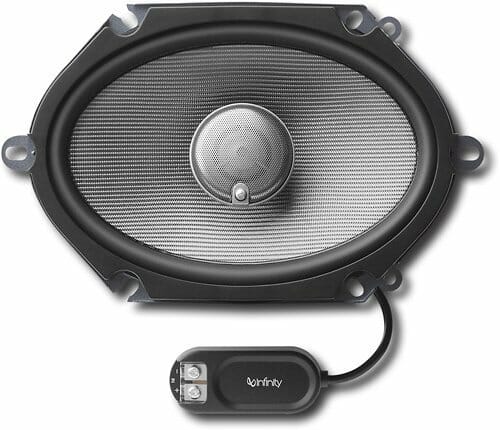
| Infinity Reference 6832CFX | 2-way coaxial | 60W | 93 dB (@2.83V) | Detailed highs, adjustable tweeter | Best for clarity |
| Pioneer TS-A6880F | 4-way coaxial | 80W | 88 dB | Loud, aggressive top end | Best for high output |
| Kicker KSC680 (KS Series) | 2-way coaxial | 75W | 90 dB | Amp-ready, thin mount | Best for amped setups |
| Kicker KSS68 (KS Series) | 2-way component | 125W (unconfirmed exact figure) | 91 dB (unconfirmed) | Separate tweeters, staging | Best component option |
| Rockford Fosgate Prime R168X2 | 2-way coaxial | 55W (unconfirmed exact figure) | Not confirmed | Tight budgets | Best budget pick |
A note on the two unconfirmed lines: the Kicker KSS68 component set and the Rockford Prime R168X2 are current 6×8 products, but I could not verify their exact RMS and sensitivity to the same source-confirmed standard as the others, so treat those figures as approximate and check the box before you buy.
The Reviews: Who Each 6×8 Pair Is Actually For
JBL GX8628 – Best All-Round Value
The GX8628 is the pair we recommend to people who ask for “just make it sound better” without a whole plan. It is a 2-way coaxial rated at 60W RMS with a soft dome tweeter and JBL’s Plus One cone, which pushes a little more surface area out of the same frame. Published sensitivity is 92 dB, high enough that it wakes up on head-unit power alone. The one number to watch is impedance: JBL rates it at 2.3 ohms, so it draws a bit harder than a standard 4-ohm speaker, which is fine on most factory decks but worth knowing on a fussy amp. It also natively fits both 5×7 and 6×8 openings, which is why it lands in so many Fords.
- Pros: High sensitivity, drops into 5×7 or 6×8, clean top end, cheap enough to do all four doors.
- Cons: 2.3-ohm load is unusual, bass is polite rather than deep.
- Who it is for: Anyone keeping the factory head unit and wanting the biggest jump for the least effort.
Rockford Fosgate Punch P1683 – Best Built for the Money
The Punch P1683 is a 3-way coaxial rated at 65W RMS with 90 dB sensitivity and a 4-ohm load, and it is the one to choose if you drive your car hard and do not want to be back in a year. The cone is an injection-molded mineral-filled polypropylene with a butyl rubber surround, and that surround is the part that survives Arizona summers and Minnesota winters better than the foam ones. Published frequency response runs 65 Hz to 24 kHz. The concealed crossover keeps the install clean.
- Pros: Durable surround, honest 4-ohm load, even tonal balance, dead-simple install.
- Cons: The third “way” is marketing more than a real third driver; midbass is good, not huge.
- Who it is for: Daily drivers and work trucks that want set-and-forget reliability.
Infinity Reference 6832CFX – Best for Clarity
Infinity’s Reference 6832CFX is the detail specialist here. It is a 2-way coaxial with an edge-driven textile tweeter and an adjustable tweeter output level, so you can tame or lift the highs to match your car. Infinity publishes 60W RMS, 180W peak, and 93 dB sensitivity at 2.83V. That 2.83V rating inflates the number relative to a 1W/1m spec, so do not read it as meaningfully louder than the JBL; it is roughly comparable in real terms. Impedance is 3 ohms, and published low end reaches 49 Hz.
- Pros: Adjustable tweeter, smooth and detailed highs, good extension for a coaxial.
- Cons: The bright tweeter can be fatiguing if you leave it maxed; 3-ohm load.
- Who it is for: Listeners who care about vocals and cymbals and want to dial in the top end.
Pioneer TS-A6880F – Best for High Output
The A-Series TS-A6880F is the loud one. It is a 4-way coaxial rated at 80W RMS with 350W peak and a carbon and mica-reinforced IMPP cone, so it takes more power than most of the field. Published sensitivity is 88 dB, which is the lowest on this list, meaning it wants an amp to really open up rather than living off head-unit power. The twin PET dome tweeters give it an aggressive, forward top end that some love and some find sharp.
- Pros: High power handling, strong output when amped, stiff cone.
- Cons: Lowest sensitivity here, so it underwhelms on deck power; bright, busy top end from the extra tweeters.
- Who it is for: People adding an amp who want to play loud.
Kicker KSC680 (KS Series) – Best for Amped Setups
The KSC680 is Kicker’s KS-Series 2-way coaxial, 75W RMS, 90 dB sensitivity, 4-ohm, with a thin-mount design and a 0.75-inch tweeter. The thin mount is the quiet selling point: a lot of factory 6×8 pockets are shallow, and this frame clears grilles and window mechanisms that fatter speakers foul. Published frequency response runs 45 Hz to 21 kHz. It scales nicely with a modest amp without being fussy on a stock deck.
- Pros: Shallow mount for tight doors, honest 4-ohm load, likes a little amp power.
- Cons: Small tweeter is clean but not the most detailed; nothing exotic in the sound.
- Who it is for: Anyone with a shallow factory pocket, or a first small amp on the front stage.
Kicker KSS68 (KS Series) – Best Component Option
If you want the tweeter up high near the A-pillar instead of buried in the door, the KSS68 is a 6×8 component set: a 6×8 woofer, a separate 1-inch tweeter, and an external crossover. Moving the tweeter up lifts the soundstage onto the dash where your ears expect it, which is the whole point of going component. Kicker publishes strong power handling for this set, on the order of 125W RMS, and roughly 91 dB sensitivity, but I could not confirm those exact figures to source, so verify them before buying. Plan for more install time to mount and wire the tweeters and crossovers.
- Pros: Real soundstage height, flexible tweeter placement, high power handling.
- Cons: More work to install; exact specs unconfirmed here; usually needs an amp to justify it.
- Who it is for: Listeners chasing a proper front stage who do not mind a longer install.
Rockford Fosgate Prime R168X2 – Best Budget Pick
The Prime R168X2 is the entry point: a 2-way full-range 6×8 from a name that does not usually show up at this price. I have it around 55W RMS, but I could not confirm the exact RMS or sensitivity to source, so treat those as ballpark. It will not out-sing the JBL or the Rockford Punch above it, but against a blown factory paper cone it is a real, audible upgrade for very little money, and it carries the brand’s reputation for not falling apart.
- Pros: Cheapest way into a real brand, easy install, big jump over factory.
- Cons: Modest power handling, unconfirmed specs, entry-level top end.
- Who it is for: Tight budgets, second cars, or a quick fix for a dead factory speaker.
6×8 vs 5×7 vs 6.5: Fitment and Interchangeability
This is where most people get confused, and it matters most on Ford and GM vehicles. The short version: 6×8 and 5×7 are close cousins, and 6.5-inch is a different animal that usually needs an adapter.
6×8 and 5×7 share a mounting pattern
A 6×8 and a 5×7 use the same bolt pattern and the same basic frame footprint. The 6×8 simply has a larger cone within a similar-sized flange. That is why so many speakers, including the JBL GX8628, Infinity Reference, and Pioneer TS-A6880F above, are sold as “5×7 / 6×8” units that fit either opening. If your factory hole is a 5×7, a 6×8-labeled speaker in that dual-fit family will almost always bolt right in. The practical difference is depth and grille clearance, not the bolt holes.
The trap: a true, dedicated 6×8-only frame can be slightly too big for a 5×7 metal cutout even when the bolts line up, so if your car came with 5×7, buy a speaker explicitly listed as 5×7/6×8 compatible rather than a 6×8-only model.
6.5-inch is a round speaker in an oval hole
People often ask if they can put a 6.5-inch round speaker in a 6×8 opening because 6.5s have more model choices and often better sound per dollar. You can, but you need a mounting adapter or bracket that converts the oval 6×8 cutout to a round 6.5 pattern. Many of these adapter plates are vehicle-specific and readily available. The upside is access to the huge 6.5-inch market; the downside is the adapter adds mounting depth, so in a shallow door the round speaker plus bracket may not clear the window glass or the door card. Measure your depth first. If you are weighing that route, our guide to the best 6.5 car speakers covers the round-speaker options worth adapting to.
Quick fitment rules
- Factory 6×8: Any 6×8 here fits. Easiest case.
- Factory 5×7: Choose a speaker listed as 5×7/6×8. Avoid 6×8-only frames.
- Want a 6.5-inch: Buy a 6×8-to-6.5 adapter bracket and confirm total mounting depth against your door.
- Ford and GM specifically: Both brands mix 5×7 and 6×8 across model years, so verify your exact opening rather than trusting the model name.
Install, Fitment, and Do They Need an Amp?
The install itself
A 6×8 swap is one of the friendliest jobs in car audio. You pull the door card, unbolt four screws, unclip the connector, and bolt the new one in. Two things catch people: mounting depth and connectors. Measure your factory pocket depth before ordering, since a deep-basket speaker can hit the window regulator or the glass. And use a set of wiring adapters for your make rather than cutting the car’s harness, which keeps the install reversible.
Two upgrades I recommend every time: add closed-cell foam gaskets behind the speaker so sound does not leak into the door cavity, and put a layer of sound deadening on the outer door skin. Deadening a bare door is the cheapest way to make any 6×8 sound like it cost twice as much. Our walkthrough on how to install car speakers covers the door-card removal and deadening steps in detail.
Do 6×8 speakers need an amp?
No, and yes. None of these speakers require an amp to work; they will all play off a factory or aftermarket head unit, which is why a plug-and-play swap is so popular. That is the “no.”
The “yes” is about getting the most out of them. A factory head unit puts out only a handful of clean watts per channel, well under these speakers’ 55 to 80-plus watt RMS ratings. High-sensitivity models like the JBL (92 dB) and Infinity (93 dB @2.83V) get respectably loud on deck power. Lower-sensitivity models like the Pioneer (88 dB) are clearly holding back until you feed them more. A small 4-channel amp lets any of these reach their rated power, plays cleaner at high volume, and is the difference between “louder factory” and “actually good.” Component sets like the KSS68 essentially assume an amp to be worth the effort.
If you decide to amp the front stage, our roundup of the best car amplifier options walks through matching amp power to speaker RMS. And if you are still deciding between a coaxial and a component set, our component vs coaxial speakers breakdown explains the tradeoff in plain terms.
Frequently Asked Questions
Are 6×8 and 5×7 speakers interchangeable?
In most cases yes. They share the same bolt pattern, and many speakers are sold as dual-fit “5×7/6×8” units that drop into either opening. The exception is a dedicated 6×8-only frame, which can be slightly too large for a 5×7 metal cutout. If your car came with 5×7, buy a speaker explicitly listed as 5×7/6×8 compatible.
Can I put a 6.5-inch speaker in a 6×8 hole?
Yes, with a mounting adapter that converts the oval 6×8 cutout to a round 6.5 pattern. The catch is depth: the adapter adds mounting height, so confirm the speaker plus bracket clears your window glass and door card before buying.
Do 6×8 speakers need an amplifier?
No. They all run off a factory or aftermarket head unit. An amp is optional and only there to reach their full rated power and play cleaner when loud. High-sensitivity models sound good without one; low-sensitivity models benefit the most from added power.
Which 6×8 speaker has the best bass?
A 6×8 speaker has more cone area than a 6.5-inch, so it moves a bit more air, but none of these are subwoofers. The Rockford Punch P1683 and the amped Pioneer and Kicker options give the strongest midbass. For real low end, pair any of these with a small subwoofer rather than expecting bass from the door.
Coaxial or component 6×8: which should I buy?
Coaxial is simpler, cheaper, and drops straight in, which suits most drivers. Component sets like the Kicker KSS68 separate the tweeter so you can mount it high for a soundstage on the dash, at the cost of a longer install and usually an amp. Choose component only if staging matters to you and you are willing to do the extra work.
How long does a 6×8 speaker swap take?
For coaxials, plan on 30 to 60 minutes per door once you have the parts and a wiring adapter. Component sets take longer because you also mount and wire the separate tweeters and crossovers. Adding sound deadening while the door card is off adds time but is well worth it.
The Bottom Line
For most people keeping the factory head unit, the JBL GX8628 is the easiest strong upgrade, and the Rockford Fosgate Punch P1683 is the one to buy if durability is the priority. Add clarity with the Infinity Reference, chase output with the amped Pioneer or Kicker KSC680, or step up to the Kicker KSS68 component set if you want the tweeters up high. Whatever you pick, confirm your exact 5×7-versus-6×8 opening first, deaden the door while you are in there, and add even a small amp if you want these speakers to do everything they are rated for.
About this guide
RideBass Team
Researched from manufacturer specifications, independent tests and owner reports, and edited for accuracy by the RideBass team.