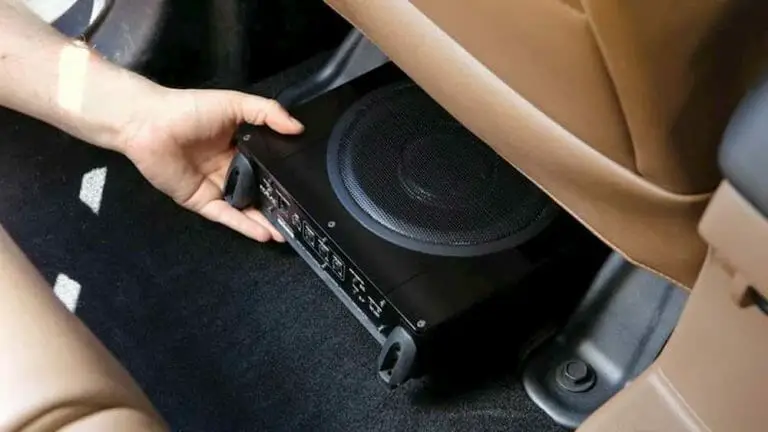
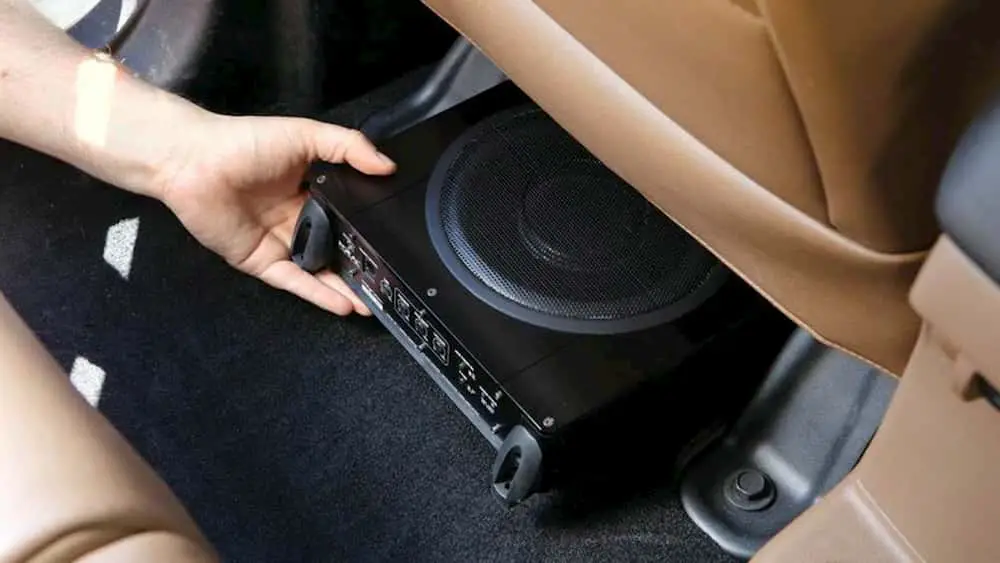
If you want more low end but have no room for a box in the trunk, an under seat subwoofer is the honest answer. This guide covers the best under seat subwoofer options for 2026, what an underseat sub can and cannot do, and how to wire one so it works the first time. The picks below are ranked, using manufacturer specifications, independent tests and owner reports, on how they sound in a real cabin, how they fit under a real seat, and how hard they are to get running, not on peak power numbers.
An under seat sub is a compact, usually powered subwoofer thin enough to slide under the front seat of a car or truck. It will not shake your mirrors like a pair of 12s in a ported box. What it will do is fill in the bottom two octaves your factory speakers give up on and tighten up kick drums and bass lines, without eating your cargo space.
Best under seat subwoofers for 2026 at a glance
Every model below is a real product you can buy in 2026. Powered means the amplifier is built into the unit, so you only run power, ground, and a signal wire. Passive means you supply your own amp. Where a spec is not published by the manufacturer or varies between listings, I have marked it rather than guess.
| Model | Sub size | RMS power | Powered / passive | Best for | Verdict |
|---|---|---|---|---|---|
| Kicker Hideaway 46HS10 | 10 in | 180W | Powered | Most daily drivers | Best overall balance of output and fit |
| Kicker Hideaway 11HS8 | 8 in | 150W | Powered | Tight footwells, coupes | Cleanest small-cabin option |
| Alpine PWE-S8 | 8 in | 120W | Powered | Refined, musical bass | Best tuned 8 in, cast metal build |
| Rockville RW10CA | 10 in | 200W | Powered | Deepest reach on a budget | Slimmest 10 in, rated to 20 Hz |
| Rockford Fosgate P300-10 | 10 in | 300W | Powered | Trunk / cargo, more output | Loudest here, not a true under-seat fit |
| JL Audio ACP110LG-TW1 | 10 in | 400W | Powered | Sound quality first | Best sounding, ported, needs more room |
| Kenwood KSC-SW11 | 8.25 x 5 in | 75W | Powered | Subtle factory-system lift | Smallest, modest but tidy |
| BOSS Audio BASS10 / Sound Storm LOPRO8 | 10 in / 8 in | Unconfirmed RMS* | Powered | Lowest cost entry | Cheapest way in, rate the power honestly |
How we evaluate under seat subwoofers
Spec sheets do not tell you how a sub behaves once it is bolted to a floor pan and fighting road noise. Here is what we actually weigh, in the order that matters for an under-seat install.
Real output, not peak power
Peak power is a marketing number. RMS, the continuous power the amp delivers, is what you feel. A well-tuned 150W to 200W RMS underseat sub in a small cabin will out-perform a 1000W peak unit that only sees a fraction of that continuously. We look at how much clean low end owners and reviewers report the unit adding before it starts to distort or the amp goes into protection.
Fit and profile height
The whole point is that it disappears under a seat. Profile height is the make-or-break dimension. Most true under-seat units land between 2.5 and 3.5 inches tall. Anything over about 4 inches will foul the seat rails in a lot of sedans. Width and depth matter too, because seat crossbars and factory wiring live down there.
Install effort and controls
A good underseat sub gives you a gain knob, a variable low-pass crossover, a phase switch, and both RCA and speaker-level inputs. Speaker-level inputs matter because most people are tapping a factory head unit with no RCA outputs. The fewer compromises you make on signal, the better it integrates.
Power draw and heat
Under a seat there is almost no airflow. A unit that runs hot will go into thermal protection on a long summer drive. I look for cast metal chassis and honest current draw. A 180W to 300W RMS class D amp usually needs an 8-gauge power wire and a 30A to 40A fuse; skimping here is the most common reason an install cuts out.
Under seat subwoofer reviews
Kicker Hideaway 46HS10 – best overall
The 46HS10 is the one we recommend most often, and for good reason. It pairs a 10 inch driver with a sealed aluminum enclosure and a 180W RMS class D amp in a chassis just over 3 inches tall. The tuning controls are complete: variable low-pass, phase, and Kicker’s KickEQ bass boost variable to +6 dB at 40 Hz. Rated response is 25 to 120 Hz, which is genuinely useful low end for a unit this size.
- Pros: Excellent output-to-size ratio, full control set, clean sealed sound, proven reliability under a seat.
- Cons: The 14 inch depth needs checking against your seat rails before you buy.
- Who it is for: The daily driver who wants a real upgrade, not a novelty, and wants it to fit and last.
Kicker Hideaway 11HS8 – best for tight cabins
The 8 inch Hideaway is the answer when the 10 inch simply will not fit, which happens in coupes and small footwells. You give up a little bottom-end weight but gain a smaller footprint, and the 150W RMS amp still moves real air. Rated response reaches into the mid-20 Hz range with a +6 dB bass boost on tap.
- Pros: Compact, tidy install, controlled and musical, easy to hide.
- Cons: Less physical slam than the 10 inch; you will notice it in bass-heavy tracks.
- Who it is for: Small cars where fit wins over maximum output.
Alpine PWE-S8 – best tuned 8 inch
Alpine builds the PWE-S8 in a cast metal enclosure that is only 3 inches at its deepest point, 13.5 inches wide and 9 inches tall. The 120W RMS (240W peak) class D amp is conservatively rated, and the variable low-pass runs 80 to 200 Hz with phase control. It is not the loudest 8 inch here, but it is the most refined; the bass is tight and it blends with factory speakers without drawing attention to itself.
- Pros: Superb build quality, musical and controlled, thermally robust, honest power rating.
- Cons: Rated 32 to 150 Hz, so it does not reach as deep as the slim 10 inch units.
- Who it is for: Listeners who care more about quality and blend than sheer volume.
Rockville RW10CA – deepest reach for the money
The RW10CA is the value play, and it earns it on two numbers: a slim enclosure only about 2.7 inches tall and a rated response reaching 20 Hz, from a 10 inch driver on a 200W RMS class D amp. Bass boost is generous and the auto-on/remote turn-on makes wiring simpler. Build quality is not Alpine or Kicker level, but for the price the output is hard to argue with.
- Pros: Slimmest 10 inch here, low bass reach, strong value, plenty of adjustment.
- Cons: Aggressive bass boost can get boomy if you set it and forget it; tune it carefully.
- Who it is for: Budget builds that still want real depth and a low-profile fit.
Rockford Fosgate P300-10 – more output, not truly under-seat
The P300-10 is a 10 inch driver with a built-in 300W RMS amp in a sealed enclosure. At roughly 13.3 inches high it is not going under a seat; it is a trunk or cargo-floor unit. I include it because many people searching for underseat subs actually have room for something bigger, and it is louder and cleaner at volume than any true under-seat unit here.
- Pros: Notably more output, Rockford build and support, well-behaved amp.
- Cons: Will not fit under a seat; needs trunk or cargo space.
- Who it is for: Anyone whose real constraint is “no big box,” not “must fit under the seat.”
JL Audio ACP110LG-TW1 – best sound quality
The MicroSub+ pairs JL’s 10TW1 driver with a 400W RMS DCD amplifier in a slot-ported enclosure measuring about 21 by 13.5 by 6.6 inches. It is the best sounding option here by a clear margin; the efficient DCD amp and ported box give output and low-end extension that shame the slim units. The catch is size: at 6.6 inches deep it needs behind-seat or cargo space in most vehicles.
- Pros: Reference-grade sound, strong ported output, efficient amp, excellent engineering.
- Cons: Largest and most expensive here; rarely a genuine under-seat fit.
- Who it is for: Sound-quality buyers with a little more room than a footwell.
Kenwood KSC-SW11 – smallest, subtle lift
The KSC-SW11 is the compact-of-compacts: an 8.25 by 5 inch oval driver with a 75W RMS built-in amp and a wired remote, rated 35 to 125 Hz. It will not transform a system, but it adds a tasteful layer of warmth under a factory setup and fits places nothing else will. Think of it as filling a gap rather than making a statement.
- Pros: Tiny, easy to hide, wired remote, tidy for factory systems.
- Cons: Modest output; not for anyone chasing real slam.
- Who it is for: Drivers who want a subtle improvement in the smallest possible package.
BOSS BASS10 and Sound Storm LOPRO8 – cheapest way in
These are the entry-price units, and I group them because the caveat is the same. BOSS advertises 1000W peak and Sound Storm 600W peak, but neither publishes a clean, conservative RMS figure, so I am marking the RMS as unconfirmed. Real continuous output is a fraction of those peak numbers. They will add bass and they are cheap, but set expectations accordingly and do not over-drive them.
- Pros: Lowest cost, easy to find, gets a first-time sub on the road.
- Cons: Peak-heavy marketing, softer build, less refined output.
- Who it is for: First powered sub on a tight budget with realistic expectations.
Under-seat vs enclosed sub: honest tradeoffs
Both have their place, and we would rather tell you the truth than sell you the smaller one. Here is the actual trade.
Output and depth. A ported 12 inch in a proper enclosure will always out-move and out-reach an under-seat sub. Physics does not care about clever chassis design. If your goal is to feel the bass in your chest, an enclosed sub wins every time.
Space and stealth. This is where under-seat wins outright. It keeps your trunk, it hides completely, and it does not announce itself to anyone who opens your doors. For daily drivers, work trucks, and leased cars where a big box is out of the question, that is often the whole decision.
Install complexity. A powered under-seat unit is one of the simplest sub installs there is: power, ground, signal, done. An enclosed passive sub means also mounting and wiring a separate amp, which is more time, more wire, and more that can go wrong. Enclosed setups also give you far more room to dial in a system; under-seat units are more of a set-and-blend proposition.
My rule of thumb: if the constraint is truly “no room for a box,” buy the best powered under-seat unit you can. If it is really “I do not want a huge box but I have some space,” step up to the JL MicroSub+ or Rockford P300-10 for the headroom.
Install and wiring basics
A powered under-seat sub needs four connections done right. None of this is hard, but the details are where installs fail.
- Power. Run a fused power wire from the battery to the sub. For a 150W to 300W RMS unit, use 8-gauge wire with a 30A to 40A fuse within 12 inches of the battery positive terminal. Undersized power wire is the number one cause of an underseat sub cutting out on bass hits.
- Ground. Bolt the ground to bare metal chassis, not to a factory ground point or paint. Scrape to clean metal and use a star washer. A bad ground causes noise and clipping.
- Remote turn-on. Tap the head unit’s remote/amp turn-on lead, or use the sub’s auto-on / speaker-level sensing if it has it. This tells the sub to power up with the stereo.
- Signal. If your head unit has RCA outputs, use them. If it does not, which is most factory systems, use the sub’s speaker-level (high-level) inputs tapped off the rear or front speaker wires. Match left and right correctly and observe polarity.
Then set it up in this order: crossover, phase, gain. Start with the low-pass around 80 Hz, set gain low, and bring it up until the bass blends with your speakers rather than overpowering them. Flip the phase switch and keep whichever setting sounds fuller at the driver’s seat. Set the bass boost last, and use it sparingly; most people over-boost and turn clean bass into mud.
If you have never done this, our guide on how to install a car subwoofer walks through the power and grounding steps in detail. For choosing an external amp on a passive build, see our best car amplifier picks.
How much power do you really need?
For an under-seat sub, the sweet spot is 150W to 300W RMS. Below about 100W RMS you are in subtle-lift territory, fine for a small factory system but not for real impact. Above 300W RMS you are usually into units too large to actually fit under a seat, at which point you should be looking at an enclosed sub instead. Match the sub’s RMS rating to an honest power wire and fuse and you will get clean, reliable bass. Chasing peak-power numbers is how people end up with a hot amp in protection mode.
Frequently asked questions
Do under-seat subwoofers sound good?
A good one sounds genuinely good for what it is: it adds clean, tuneful low end that your factory speakers cannot produce, and it blends into the music rather than booming over it. It will not match a large enclosed sub for depth or volume, but for filling in the bottom octaves in a normal cabin, a well-tuned under-seat unit is very satisfying.
Powered or passive: which under-seat sub should I get?
For under-seat use, powered almost always wins. A powered unit has the amp built in, tuned to the driver and enclosure, so you only run power, ground, and signal. Passive under-seat subs exist but mean also finding room for a separate amp, which defeats much of the space advantage. Go passive only if you already have a suitable amp and a specific reason.
Do under-seat subwoofers need a separate amp?
Powered models do not. The amplifier is inside the unit, which is the whole point. Only passive under-seat subs need an external amp. If you are buying your first sub and want the simplest install, choose a powered model and skip the separate amp entirely.
How much power does an under-seat sub need?
150W to 300W RMS is the practical range for an under-seat unit. That is enough for clean, satisfying bass in most cars and SUVs without needing an enclosure. Focus on the RMS figure, not peak power, and wire it to match: 8-gauge power wire and a 30A to 40A fuse for units in that range.
Will an under-seat subwoofer fit under my seat?
Check the profile height first, then depth and width. True under-seat units are usually 2.5 to 3.5 inches tall; anything taller will likely foul the seat rails. Measure the clear space under your seat with the seat in its normal position, and account for seat crossbars and factory wiring. If the numbers are tight, an 8 inch unit like the Kicker 11HS8 or Alpine PWE-S8 fits where a 10 inch will not.
Can I add an under-seat sub to a factory stereo with no RCA outputs?
Yes, and most people do. Use the sub’s speaker-level (high-level) inputs and tap them off the factory speaker wires. Any of the powered units here that list high-level inputs will integrate with a factory head unit without an aftermarket stereo. Just match channels and polarity when you tap.
The bottom line
For most drivers in 2026, the Kicker Hideaway 46HS10 is the best under seat subwoofer: it fits, it is easy to wire, and it delivers real bass without the drama. Drop to the 8 inch Kicker 11HS8 or the Alpine PWE-S8 if your cabin is tight, chase value with the slim Rockville RW10CA, and step up to the JL MicroSub+ or Rockford P300-10 if you actually have room for something bigger. Whatever you pick, wire it properly, tune it patiently, and rate the power honestly, and a small sub will punch well above its size.
Want more bass than an under-seat unit can give? See our full best car subwoofer guide, and if you are also upgrading your door speakers, our best 8 inch speakers picks pair well with any of these subs.
About this guide
RideBass Team
Researched from manufacturer specifications, independent tests and owner reports, and edited for accuracy by the RideBass team.