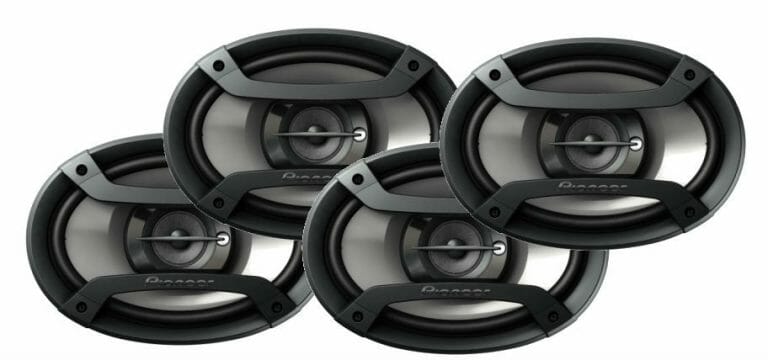
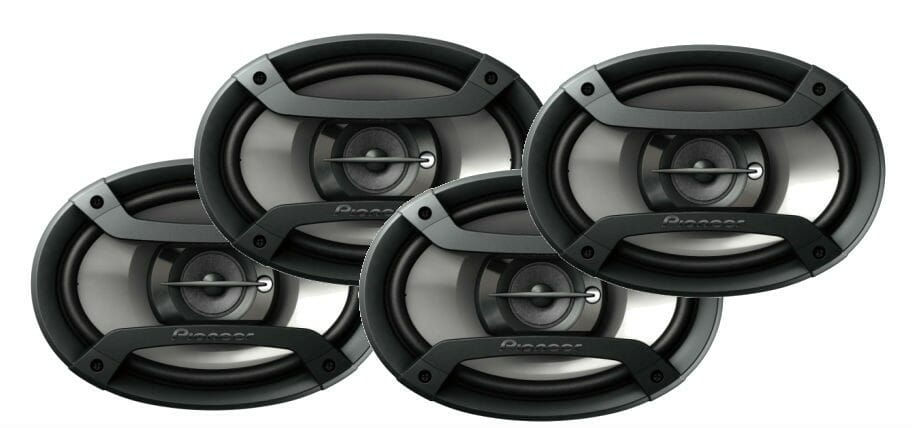
A 3-way speaker is a single speaker that uses three separate drivers to cover the full range of sound: a woofer for the lows, a midrange for the middle, and a tweeter for the highs. Instead of asking one or two cones to reproduce everything from a kick drum to a cymbal, a 3-way splits the job across three purpose-built drivers so each one only handles the frequencies it does well.
That is the short answer. But if you are shopping for car speakers and staring at boxes labeled “2-way,” “3-way,” and “4-way,” the real question is not just what the term means. It is whether a 3-way is actually the right call for your car, your budget, and how you listen. Here is the honest version, drawn from manufacturer specifications, independent tests and owner reports, so let’s go deeper than a dictionary definition.
What a 3-Way Speaker Actually Is
Sound sits on a spectrum, roughly 20 Hz at the low end (the deep rumble you feel in your chest) up to 20,000 Hz at the top (the airy sparkle of a hi-hat). No single cone can move fast enough for the highs and far enough for the lows at the same time. So multi-way speakers divide the work.
A 3-way speaker contains three drivers, each tuned to a slice of that spectrum:
- Woofer: the largest driver, usually the main cone you see. It handles the low frequencies, roughly 40 Hz to 500 Hz. This is your bass and lower-body of the mix. In a car speaker the woofer is also what determines the “size” on the box (6.5-inch, 6×9, and so on).
- Midrange: a smaller driver dedicated to the middle band, roughly 500 Hz to 4,000 Hz. This is the most important range for music because it carries vocals, guitars, pianos, and most of what your ear latches onto. Giving the midrange its own driver is the entire point of a 3-way.
- Tweeter: the smallest driver, handling the highs from about 4,000 Hz up to 20,000 Hz. This is detail and air: cymbals, string texture, the crispness of a voice.
The part that makes it all work is the crossover, a small circuit that acts like a traffic cop. It filters the incoming signal and sends only the right frequencies to each driver: lows to the woofer, mids to the midrange, highs to the tweeter. Without a crossover you would be feeding cymbal frequencies into a woofer that can’t reproduce them and bass into a tweeter that would tear itself apart trying. In a 3-way, the crossover has two split points instead of one, which is exactly what separates it from a 2-way.
How a 3-Way Differs From a 2-Way and a 4-Way
The number just counts how many frequency bands the speaker splits the signal into.
A 2-way speaker has two drivers: a woofer that covers the lows and the mids, plus a tweeter for the highs. One crossover point. It is the most common car speaker on the road because it is simple, affordable, and genuinely good. The trade-off is that the woofer is doing double duty, covering both bass and the critical midrange, so the mids can lose a little clarity when the music gets busy.
A 3-way speaker adds a dedicated midrange driver so the woofer can focus purely on bass while a separate driver handles vocals and instruments. Two crossover points. In theory, cleaner mids and better separation.
A 4-way speaker usually adds a second, smaller tweeter (a “super tweeter”) on top of the woofer, midrange, and main tweeter to push the very top of the treble even further. In practice, in a car, most 4-way coaxials are more about the marketing spec than a meaningful jump in sound. That fourth driver is often a tiny piezo tweeter that adds very little.
2-Way vs 3-Way vs 4-Way at a Glance
| Feature | 2-Way | 3-Way | 4-Way |
|---|---|---|---|
| Drivers | Woofer + tweeter | Woofer + midrange + tweeter | Woofer + midrange + tweeter + super tweeter |
| Crossover points | 1 | 2 | 3 |
| Sound character | Clean, balanced, easy to drive | More separation, fuller mids when built well | Extra treble sparkle, often marginal in practice |
| Best for | Most drivers, factory-style upgrades, tight budgets | Listeners who want detailed mids and vocals | Spec chasers; rarely a real upgrade over a good 3-way |
| Downsides | Mids share duty with bass | Costs more, quality varies wildly by brand | Extra driver is often cheap and adds little |
Coaxial 3-Way vs Component 3-Way
This distinction matters more than the driver count, because it changes how the speaker sounds in your car and how hard it is to install.
A coaxial (full-range) 3-way stacks all three drivers on a single frame. The woofer forms the main cone, and the midrange and tweeter are mounted on a post in the center. Everything drops into your factory speaker location as one unit. Coaxials are the plug-and-play option: affordable, easy, and a solid upgrade over factory speakers. The catch is that because the drivers are stacked in one spot, the sound comes from a single point low in your door, which limits the sense of stereo width and staging.
A component 3-way ships the drivers as separate pieces: a standalone woofer, a standalone midrange, a standalone tweeter, and an external crossover. You mount each driver where it performs best. The tweeter and midrange typically go higher up (A-pillars or the top of the door), which lifts the soundstage to ear level and creates a much wider, more realistic image where vocals sound like they are in front of you rather than by your knees. Components sound noticeably better, but they cost more and the install is real work: more wiring, more fabrication, and finding a home for the crossover.
My rule of thumb: a good 2-way component set will almost always beat a mediocre 3-way coaxial. Coaxial-vs-component is a bigger sound decision than the number of drivers. If you want the difference broken down further, see our guide on component vs coaxial speakers.
Do 3-Way Speakers Actually Sound Better?
Here is the honest answer: sometimes, and it depends entirely on quality.
A well-engineered 3-way with a proper midrange driver and a good crossover can sound cleaner and more detailed than a 2-way, especially in the vocal range. When the woofer no longer has to strain to reproduce mids, busy tracks stay composed and voices sit clearly in the mix. That is the ceiling a 3-way is reaching for.
But a cheap 3-way can easily sound worse than a good 2-way. Cramming a third driver and a second crossover point into a budget speaker means the manufacturer cut corners somewhere: a flimsy midrange, a harsh piezo tweeter, or a crossover that doesn’t blend the drivers smoothly, leaving audible gaps or peaks. More drivers give a designer more ways to get it right and more ways to get it wrong.
So the driver count is not a quality rating. A $60 3-way coaxial is not automatically better than a $120 2-way component. What actually determines sound quality is driver materials, crossover design, magnet strength, and how well the whole system is tuned, not the number on the box.
What Actually Matters (and Common Myths)
- Myth: More drivers always mean better sound. No. A great 2-way beats a poorly built 3-way or 4-way every time. Build quality and crossover design outrank driver count.
- Myth: 3-way speakers give you more bass. Not really. The woofer size and enclosure determine bass output. A 6.5-inch 3-way and a 6.5-inch 2-way have similar bass because they share a similar-size woofer. Real bass comes from a subwoofer, not from adding a midrange.
- Myth: The “4-way” on the box is a real upgrade. Usually it is a token super tweeter that adds very little. Don’t pay a premium for the number alone.
- What matters: coaxial vs component. Where the tweeter and midrange sit changes your soundstage far more than the driver count does.
- What matters: power and source. Feeding good speakers a clean, adequately powered signal does more for sound than one extra driver ever will.
- What matters: the install. Sound deadening, proper mounting, and sealing the door do more for real-world sound than most people expect.
When to Choose a 3-Way vs a 2-Way
Choose a 2-way if you want the best value, a straightforward factory-location upgrade, or you plan to add a subwoofer anyway (which offloads the bass and makes the 2-way’s shared-duty woofer a non-issue). For most people upgrading tired factory speakers on a budget, a quality 2-way is the smart, no-drama choice. Our roundup of the best 6.5 car speakers is mostly 2-way sets for exactly this reason.
Choose a 3-way if you care about vocal clarity and midrange detail, you are buying from a reputable brand where the third driver is a real, well-integrated midrange (not a spec-sheet piezo), and ideally you are willing to go component so you can mount the midrange and tweeter up high. A good 3-way component set is where you get the most out of the format.
A speaker like the Polk DB651 shows how much a well-tuned 2-way coaxial can deliver, which is a useful reality check before you assume you need to jump to 3-way. For the full landscape across sizes and types, our best car speakers guide lays out the options.
Install and Power Considerations
Before you buy a 3-way, think about what it takes to run it well.
- Do 3-way speakers need an amp? They don’t strictly require one. Coaxial 3-ways run fine off your head unit, just like 2-ways. But 3-ways (especially components) reward extra clean power, and a modest external amp will let them open up, play louder without distortion, and keep the midrange composed at volume. If you go component, an amp is strongly recommended.
- Fitment. Coaxial 3-ways drop into a standard speaker location, but they are often deeper than a 2-way because of the center-mounted drivers. Check your mounting depth before buying, especially in shallow door pockets.
- Component installs are a project. You need a spot for the external crossover, a run to mount the tweeter and midrange up high (A-pillar or sail panel), and more wiring. Budget the time or the shop cost.
- Match the power. Look at RMS ratings, not peak. Feed the speaker power in its RMS range from the head unit or amp. Underpowering causes clipping, which kills more speakers than too much power does.
- Deaden the door. A layer of sound deadening on the door skin tightens up the bass and cuts rattles. It is the cheapest upgrade that makes any speaker, 2-way or 3-way, sound better.
Frequently Asked Questions
Are 3-way speakers better than 2-way?
Not automatically. A well-built 3-way can sound cleaner in the midrange and offer more separation, but a good 2-way easily beats a cheap 3-way. Build quality, crossover design, and coaxial-vs-component matter more than the driver count.
Do 3-way speakers need an amp?
No, coaxial 3-ways will run off your head unit. But they sound their best with a clean external amp, and component 3-way sets really should be amplified to get the volume and clarity you paid for.
Are 3-way speakers good for bass?
They are fine for the everyday low end, but they are not a bass solution. Bass output comes from the woofer size and enclosure, not the number of drivers, so a 3-way and a 2-way of the same size produce similar bass. For real low-end punch, add a subwoofer.
What is the difference between 3-way and component speakers?
These describe two different things. “3-way” is the number of drivers (woofer, midrange, tweeter). “Component” is how they are packaged: as separate pieces you mount individually versus all-in-one coaxials. You can have a 3-way coaxial or a 3-way component set. Component sets sound better because you can position the tweeter and midrange up at ear level.
What is a 3-way speaker best used for?
A 3-way is best for listeners who prioritize detailed, clear midrange and vocals, and who are buying a quality set (ideally component) from a reputable brand. If you want a simple, budget-friendly factory upgrade or you are pairing your speakers with a subwoofer, a 2-way is usually the better value.
Is a 4-way speaker better than a 3-way?
Rarely by a meaningful margin. Most car “4-way” speakers just add a small super tweeter that contributes little over a good 3-way. Don’t choose a speaker on the driver count alone; judge it on build quality, brand reputation, and whether it is coaxial or component.
The Bottom Line
A 3-way speaker splits sound across three drivers (woofer, midrange, tweeter) so each handles the frequencies it does best, with the midrange getting its own dedicated driver. That can mean cleaner, more detailed sound, but only when the speaker is well built. The number on the box is not a quality score. If you want the most out of a 3-way, go component so you can mount the tweeter and midrange up high, give it clean power, and take the install seriously. For a lot of drivers, though, a quality 2-way plus a subwoofer is the smarter, better-sounding path, and there is no shame in that.
About this guide
RideBass Team
Researched from manufacturer specifications, independent tests and owner reports, and edited for accuracy by the RideBass team.