
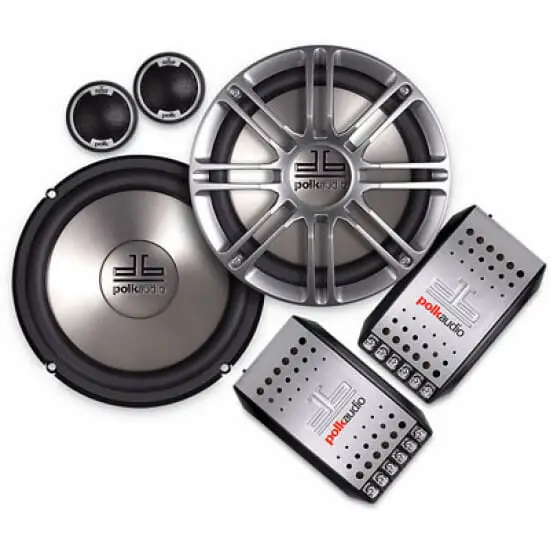
The Polk Audio DB6501 is a genuinely good 6.5-inch component set for the money, and it earns that with a clean, extended top end and a factory-grade Butterworth crossover that most sets in this price range skip. It is not a bass monster and the tweeter can get bright if you aim it wrong, but as a first real upgrade over factory door speakers it is one of the easiest recommendations I can make.
The DB6501 and its coaxial sibling (the DB651) have a long record in owner reports and independent reviews, so the family strengths and weaknesses are well known. This review draws on that record, not on a spec sheet alone. Below are the real published numbers, what the set actually sounds like once it is in a door, how the component layout installs, and how it stacks up against the DB651 and competitors in the same class.
Polk Audio DB6501 specs
These are the DB6501’s real published specifications from Polk’s DB+ series documentation. Where a number is commonly misquoted (usually by confusing it with the coaxial DB651), I have flagged it.
| Specification | Polk Audio DB6501 |
|---|---|
| Type | 6.5-inch (also fits 6.75-inch openings) 2-way component system |
| RMS (continuous) power | 100 watts per speaker |
| Peak power | 300 watts per speaker |
| Sensitivity | 92 dB |
| Frequency response | 35 Hz to 23 kHz |
| Tweeter | 1-inch (25 mm) liquid-cooled silk/polymer composite dome, neodymium magnet |
| Woofer | 6.5-inch polymer/mica composite cone, rubber surround |
| Crossover | 2nd-order Butterworth outboard crossover, 3-position tweeter level switch (-3 dB / 0 dB / +3 dB) |
| Impedance | 4 ohms |
| Mounting depth | Approx. 57 mm (2.25 inches) |
| Certification | Marine certified (IP-rated for moisture) |
One number worth pinning down because it gets muddled constantly online: the DB6501 component set is rated 100 watts RMS / 300 watts peak per speaker. The coaxial DB651 is a different rating (60 watts RMS / 180 watts peak). If you see a listing quoting 60W RMS for the DB6501, it is copying the coaxial’s spec. Buy and amplify to the 100W RMS figure.
How the DB6501 sounds
Component sets let you put the tweeter up high near ear level and the woofer down low in the door, and that separation is the DB6501’s biggest sonic advantage over any coaxial. Set up properly, the soundstage sits up on the dash instead of down at your knees, which alone makes music feel more like a system and less like a car stereo.
Highs
The 1-inch liquid-cooled silk dome is the star here. It is detailed and airy, and it reproduces cymbals, hi-hats, and vocal sibilance with more resolution than you have any right to expect at this price. The trade-off is that it can lean bright, and on a poorly recorded track or with the level switch set to +3 dB it will cross into harsh. This is exactly why Polk gave it a 3-position switch. In most doors, aiming the tweeter slightly off-axis and running the switch at 0 dB or -3 dB tames the top end without dulling it. If your ears are sensitive to treble, start at -3 dB.
Mids
Midrange is clean and honest. Vocals sit forward, and because the crossover hands off to a real outboard network rather than an in-line capacitor, the transition from woofer to tweeter is smooth. You do not get the disjointed, two-speakers-fighting quality that cheaper “component” sets sometimes have. It is not a warm, romantic midrange; it is neutral and accurate, which I prefer, but people chasing thick vocals may want a touch of EQ.
Bass
This is where you need honest expectations. The 6.5-inch woofer does produce real, usable midbass, and unlike a lot of budget speakers it will give you a satisfying kick drum even off head-unit power. But it is a 6.5-inch driver in a car door. It will not shake your seat, and if you push it hard for low bass without a subwoofer it starts to strain and the cone runs out of excursion. The published 35 Hz figure is a lab number; in a real door you are realistically getting solid output down into the 60-80 Hz range. Pair it with even a small sub and the whole system comes alive, and the DB6501 is happier playing midbass than trying to be the whole range.
Build quality
Build is a strong point for the DB+ line. The woofer uses a polymer/mica composite cone with a proper rubber surround, not the foam surrounds that dry out and crack after a few summers. The tweeter’s neodymium motor keeps it compact enough for tight tweeter pods. The whole set is marine certified, which means the materials and adhesives are chosen to survive humidity, temperature swings, and the occasional splash. That is genuinely useful in a car door, a wet, hot, vibration-heavy environment even if you never take it near a boat.
One build note from long-term owner reports: the grilles and some trim hardware feel more budget than the drivers themselves, and a few owners report cosmetic pieces wearing before the speaker does. The actual audio components hold up well. Nothing feels disposable where it counts.
Installation
A component set is more work than a coaxial because you are mounting three things per side instead of one: the woofer, the tweeter, and the crossover. None of it is hard, but budget more time than a straight speaker swap.
Woofers
The 6.5-inch woofers drop into standard 6.5-inch openings and also fit 6.75-inch locations, which covers a huge range of vehicles. Watch the mounting depth of roughly 57 mm (2.25 inches) before you buy. Most doors handle it fine, but shallow doors or ones with window mechanisms close to the speaker can be tight, so measure. You may need mounting adapter rings or spacers depending on the factory bracket.
Tweeters
This is the part people underestimate. The tweeters can be surface-mounted (sitting on top of a panel), flush-mounted (recessed into a hole you cut), or angle-mounted with the included cups. Where you put them matters more than any spec: up high near the A-pillar or in the sail panel gets the soundstage up onto the dash. Dropping them low in the door defeats half the reason to buy a component set. Plan tweeter placement and wiring runs before you commit.
Crossovers
Each side has an outboard crossover box that needs a home, ideally somewhere ventilated and dry inside the door cavity or behind the kick panel, not buried where it will bake or get wet. Wire the woofer and tweeter to their marked terminals on the crossover, set the tweeter level switch, and route the input from your amp or head unit to the crossover input. It is straightforward, just methodical. If you are new to this, our guide on how to install car speakers walks through door removal, wiring, and sealing.
How the DB6501 compares
The most common question is DB6501 versus the coaxial DB651, but there are two other component sets worth putting on the list.
| Model | Type | RMS / Peak | Sensitivity | Notes |
|---|---|---|---|---|
| Polk DB6501 | Component | 100W / 300W | 92 dB | Separate tweeters, real crossover, marine rated |
| Polk DB651 | Coaxial | 60W / 180W | 92 dB | One-piece, easiest install, lower cost |
| JBL GTO609C | Component | 100W / 270W | 93 dB | Louder off head-unit power, warmer tuning |
| Infinity Kappa 60.11cs | Component | 110W / 330W | 93 dB | Higher power ceiling, edge-driven tweeter |
DB6501 vs DB651 coaxial
Same family, very different products. The DB651 is a one-piece coaxial: the tweeter sits in the middle of the woofer, it drops into a single opening, and it installs in minutes. It is cheaper, it is easier, and it handles less power (60W RMS versus the DB6501’s 100W RMS). The DB6501 gives you separate tweeters you can place up high, a proper outboard crossover, higher power handling, and a noticeably better soundstage, in exchange for more installation work. If you want the best sound and are willing to run wire and mount tweeters, get the DB6501. If you want a quick, cheap factory-speaker upgrade, the DB651 is the right call. We break the whole decision down in our component vs coaxial speakers guide and the full DB651 review.
DB6501 vs JBL GTO609C
The JBL is the DB6501’s most direct rival and the two trade blows. The GTO609C runs a hair more sensitive and tends to play a little louder and warmer straight off a head unit, which some people prefer. The Polk’s silk dome is smoother and more refined up top, where the JBL’s tweeter can be a touch more aggressive. Both are excellent; the choice comes down to whether you want refinement (Polk) or a bit more forward energy (JBL).
DB6501 vs Infinity Kappa 60.11cs
The Infinity Kappa steps up the power ceiling and is built to be pushed harder with an amp. If you are running a real amplifier and want to lean into volume and dynamics, the Kappa has more headroom. The DB6501 is the more balanced, more forgiving set and the better value if you are running off head-unit power or a modest amp. For most people upgrading factory doors, the Polk is the smarter buy.
Pros and cons
Pros
- Refined, detailed silk-dome high end that punches above its price
- Real 2nd-order Butterworth outboard crossover, not an in-line cap
- 3-position tweeter level switch to tune brightness to your car and taste
- Separate tweeters let you raise the soundstage onto the dash
- Marine-certified build survives heat, humidity, and door moisture
- Fits both 6.5-inch and 6.75-inch openings for wide vehicle compatibility
- Sounds good even on head-unit power, with room to grow on an amp
Cons
- Limited low bass on its own; it wants a subwoofer to feel complete
- Tweeter can sound bright or harsh if aimed poorly or set to +3 dB
- Component install is more involved than a coaxial (three pieces per side)
- Grilles and cosmetic trim feel cheaper than the drivers
- Neutral midrange may sound lean to listeners who want warmth
Who should buy the DB6501
Buy the DB6501 if you are upgrading tired factory door speakers and you actually care how music sounds, if you are willing to spend an afternoon mounting tweeters and crossovers to get a proper soundstage, and if you either already run a subwoofer or plan to add one. It is also a strong pick for anyone in a hot or humid climate thanks to the marine build, and for the buyer who wants a smooth, refined top end rather than an aggressive, in-your-face one.
Who should skip it
Skip it if you want a plug-and-play swap with no wiring beyond the woofer opening; the coaxial DB651 is the better fit there. Skip it if you are expecting these to deliver deep, seat-shaking bass on their own without a sub; no 6.5-inch driver does that. And skip it if you are chasing maximum SPL on a big amplifier, where a higher-power set like the Infinity Kappa will have more headroom. For a broader shortlist, see our roundup of the best 6.5 car speakers.
Frequently asked questions
Are the Polk DB6501 good speakers?
Yes. For their price they are one of the better 6.5-inch component sets you can buy, thanks to a refined silk-dome tweeter, a real outboard crossover, and a marine-certified build. They are not a bass solution on their own, but as a front-stage upgrade over factory speakers they are an easy recommendation.
What is the RMS power of the DB6501?
The DB6501 component set is rated at 100 watts RMS (continuous) per speaker and 300 watts peak per speaker. Do not confuse this with the coaxial DB651, which is rated at 60 watts RMS. Amplify the DB6501 to the 100W RMS figure.
Do the DB6501 need an amp?
No, they do not require one. At 92 dB sensitivity they sound good driven directly by a decent head unit, which is part of their appeal. That said, they clean up and open up with an amplifier, and adding one lets you drive them closer to their 100W RMS rating and add a subwoofer for the low bass they lack on their own.
DB6501 vs DB651: what is the difference?
The DB6501 is a component set (separate woofer, separate tweeter, and an outboard crossover) rated at 100W RMS. The DB651 is a one-piece coaxial (tweeter mounted in the center of the woofer) rated at 60W RMS. The DB6501 sounds better and images higher but takes more work to install; the DB651 is cheaper and installs in minutes.
What is the difference between component and coaxial speakers?
Coaxial speakers combine the woofer and tweeter into a single unit that drops into one opening, so they are cheap and quick to install. Component speakers split the tweeter out as a separate driver with its own crossover, letting you mount the tweeter up high for a better soundstage and generally delivering cleaner, more detailed sound. Components cost more and take longer to install.
How hard is the DB6501 to install?
Moderate. The woofers drop into standard 6.5-inch or 6.75-inch openings, but you also have to mount a separate tweeter (ideally up high near the A-pillar) and find a ventilated, dry home for each crossover box. There is no soldering required and the terminals are labeled, but plan on an afternoon and check your door’s mounting depth (about 57 mm) before you start.
About this guide
RideBass Team
Researched from manufacturer specifications, independent tests and owner reports, and edited for accuracy by the RideBass team.