
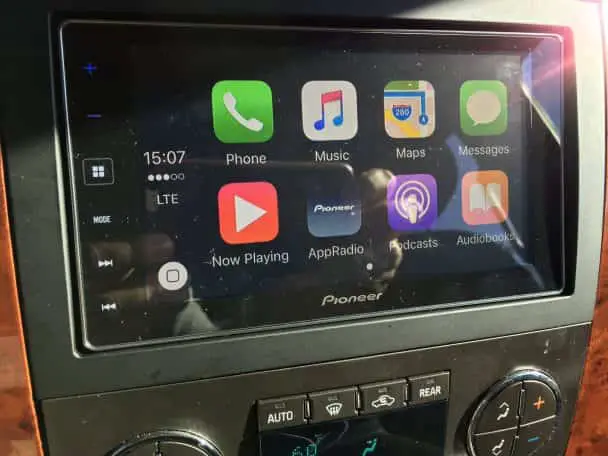
If you want a Pioneer touch screen car stereo, this guide sorts the current lineup into the handful of units actually worth wiring into your dash. The picks below draw on manufacturer specifications, independent tests and owner reports, so they are about fit, screen quality, and how the CarPlay handoff behaves in real driving, not spec-sheet bragging.
Pioneer splits its touchscreen receivers into three families: the modular floating-screen DMH-WT units for dashes that will not swallow a big screen, the flush in-dash DMH-W and DMH receivers for standard double-DIN openings, and the AVH series for anyone who still wants a disc slot. Below is a straight comparison of eight real 2026 models, then a short review of each, followed by the buying logic you need before you commit.
Best Pioneer touchscreen car stereos at a glance
| Model | Screen | DIN chassis | Mount style | Wireless CarPlay | Best for | Verdict |
|---|---|---|---|---|---|---|
| DMH-WT8600NEX | 10.1″ | Single-DIN body | Floating | Wireless + wired | Biggest screen in a small opening | Top of the range, best display |
| DMH-WT7600NEX | 9″ | Single-DIN body | Floating | Wireless + wired | Big screen without a 10″ wall | The sweet-spot floating unit |
| DMH-WT3800NEX | 9″ | Single-DIN body | Floating | Wireless + wired | 9″ screen on a tighter budget | Value floating pick |
| DMH-W3000NEX | 6.8″ | Double-DIN | In-dash flush | Wireless + wired | Clean OEM-style install | Best flush double-DIN |
| AVH-W4500NEX | 7″ | Double-DIN | In-dash flush | Wireless + wired | Wireless plus a disc drive | Best disc unit with wireless |
| DMH-2660NEX | 6.8″ | Double-DIN | In-dash flush | Wired only | Flush install, wired is fine | Solid wired workhorse |
| AVH-2550NEX | 6.8″ | Double-DIN | In-dash flush | Wired only | Disc playback on a budget | Best value DVD receiver |
| DMH-260BT | 6.8″ | Double-DIN | In-dash flush | Wireless + wired | Cheapest wireless CarPlay | Best budget entry point |
Pioneer DMH-WT8600NEX: the flagship floating screen
The WT8600NEX is the unit people picture when they say they want a big Pioneer screen. It is a 10.1-inch capacitive floating display bolted to a single-DIN chassis, so the screen hovers in front of the dash while the electronics tuck into a small opening. Owner reports and independent reviews rate the panel as the most responsive Pioneer sells, with clean touch tracking and no ghost inputs during a CarPlay swipe.
Wireless and wired CarPlay and Android Auto both work, Alexa is built in, and there is HD Radio and a backup camera input. Sound tuning is deep, with the full graphic EQ and time alignment you would expect at the top of the line.
- Pros: Largest, sharpest Pioneer screen; wireless CarPlay reconnects fast; fits cars that cannot take a flush 10″ unit.
- Cons: A 10″ floating screen can crowd a small dash and block vents; you pay for the size.
- Who it is for: Drivers who want maximum screen real estate and do not have a double-DIN opening to spare.
Pioneer DMH-WT7600NEX: the floating unit we recommend most
The WT7600NEX drops to a 9-inch floating capacitive display on the same single-DIN modular body. For most dashes this is the smarter buy than the 10.1″, because 9 inches clears the instrument cluster and vents in more vehicles while still feeling large next to a stock head unit.
It carries wireless and wired CarPlay and Android Auto, built-in Bluetooth, Wi-Fi, Alexa, and HD Radio. The screen is HD and the mounting arm adjusts for depth and angle, which matters more than buyers expect when they are dodging a curved dash.
- Pros: Big screen that actually fits; adjustable float arm; full wireless smartphone mirroring.
- Cons: Still a floating design, so it will not look factory-flush; single-DIN wiring pocket can be tight behind the arm.
- Who it is for: The default pick for anyone who wants a large Pioneer screen without the 10″ footprint.
Pioneer DMH-WT3800NEX: 9 inches for less
The WT3800NEX is the value entry in the floating range. You still get a 9-inch capacitive floating display and wireless plus wired CarPlay and Android Auto, but Pioneer trims some of the higher-end tuning and connectivity extras to bring the price down.
Owners report the screen looks very close to the 7600 at a glance, and the wireless handoff is just as reliable. If you are choosing a floating unit mainly for the size and wireless CarPlay rather than the deepest audio processing, this is where the money stops making sense to spend.
- Pros: Same 9″ floating footprint for less; wireless CarPlay and Android Auto included; easy dash fit.
- Cons: Fewer tuning and connectivity features than the WT7600NEX; still a floating install.
- Who it is for: Budget-minded buyers who want a 9″ floating screen and can skip the flagship extras.
Pioneer DMH-W3000NEX: the cleanest flush install
If you want the screen to sit flat in the dash instead of floating in front of it, the W3000NEX is the pick. It is a true double-DIN unit with a 6.8-inch capacitive touchscreen that fills a standard opening, so the finished install reads as close to factory as an aftermarket Pioneer gets.
Despite the smaller screen, it does not cut the important feature: wireless and wired CarPlay and Android Auto are both here, along with Bluetooth and camera support. Reviewers report the touch response is quick and the one-touch navigation shortcut is genuinely useful with gloves on.
- Pros: Flush OEM-style look; wireless CarPlay in a double-DIN body; no floating arm to fuss over.
- Cons: 6.8″ is small next to the floating units; no disc drive.
- Who it is for: Drivers with a double-DIN dash who want wireless CarPlay and a clean flush finish.
Pioneer AVH-W4500NEX: wireless CarPlay with a disc drive
The AVH line is where Pioneer keeps the disc slot alive, and the W4500NEX is the one to get if you still burn to CD or watch DVDs while parked. It is a double-DIN receiver with a 7-inch capacitive touchscreen and, unusually for the AVH range, full wireless and wired CarPlay and Android Auto.
You get HD Radio, SiriusXM-Ready tuning, Bluetooth, and Pioneer’s three sets of high-voltage preouts for anyone building out amps. It is the bridge unit for buyers who refuse to give up physical media but still want the modern wireless phone experience.
- Pros: Rare combination of disc playback and wireless CarPlay; strong preouts for a full system; flush 7″ fit.
- Cons: Bulkier chassis to house the drive; screen is smaller than the floating units.
- Who it is for: Anyone who wants wireless CarPlay but is not ready to abandon CDs and DVDs.
Pioneer DMH-2660NEX: the wired flush workhorse
The DMH-2660NEX is a 6.8-inch double-DIN in-dash receiver that keeps the modern digital-media platform but drops to wired-only CarPlay and Android Auto. That single change knocks the price down, and for a lot of drivers a plug-in cable is a non-issue since the phone charges while it is connected anyway.
It keeps the useful stuff: 13-band graphic EQ, time alignment, two camera inputs, HD Radio, and Alexa through Pioneer’s voice platform. Owners report it behaves like the wireless units once the cable is in; you just give up the auto-reconnect.
- Pros: Full flush double-DIN feature set; strong EQ and dual camera inputs; lower price than the wireless twins.
- Cons: No wireless CarPlay, so you plug in every drive; 6.8″ screen.
- Who it is for: Flush-install buyers who do not mind a cable and want to save money.
Pioneer AVH-2550NEX: the value DVD receiver
The AVH-2550NEX is the budget disc unit. It is a double-DIN 6.8-inch touchscreen DVD receiver with wired CarPlay and Android Auto, HD Radio, and SiriusXM-Ready tuning. Power is the standard 22 watts continuous by four channels with 50-watt peaks, which is normal for the class and why most owners still add an amp for real output.
There is nothing flashy here, and that is the point. If you want disc playback, a competent touchscreen, and wired phone mirroring without paying for wireless, this is the sensible floor.
- Pros: Disc drive plus CarPlay at a low price; HD Radio included; proven, stable platform.
- Cons: Wired only; modest onboard power; smaller WVGA-class screen.
- Who it is for: Value buyers who need a disc slot and are fine with a cable.
Pioneer DMH-260BT: cheapest way into wireless CarPlay
The DMH-260BT is Pioneer’s entry point for wireless CarPlay. It is a 6.8-inch double-DIN unit with wireless and wired CarPlay and Android Auto plus Bluetooth, but it strips out the extras: no HD Radio, no built-in navigation shortcut layer, and lighter audio tuning than the NEX units.
For a daily commuter where the phone does all the work, that trade is fine. You get the wireless phone experience that used to cost a lot more, in a flush double-DIN body, and you spend the savings elsewhere.
- Pros: Wireless CarPlay at the lowest price in the lineup; flush double-DIN fit; simple to live with.
- Cons: No HD Radio; fewer tuning and camera features; the plainest screen here.
- Who it is for: Commuters who only care about wireless CarPlay and want to spend the least.
The Pioneer lineup decoded: DMH vs AVH, floating vs in-dash, NEX
Pioneer’s naming looks like alphabet soup until you learn the three rules behind it. Once you do, you can read any model number and know what it is.
DMH vs AVH
DMH stands for the digital-media platform: no disc drive, all streaming, phone mirroring, and radio. AVH is the audio-video-hybrid line that still includes a CD/DVD slot. If you never touch physical media, DMH is lighter and usually a better value. If you still play discs, you want AVH.
Modular floating vs in-dash flush
This is the split that trips people up most. The DMH-WT units are modular: the screen floats on an adjustable arm in front of the dash, and the electronics live in a small single-DIN body behind it. That is how Pioneer fits a 9″ or 10″ screen into a car that only has a small opening. The DMH-W, DMH, and AVH units are in-dash flush: the screen fills a standard double-DIN hole and sits flat, for an OEM look but a smaller screen. Floating wins on size, flush wins on the factory-clean finish.
What NEX means
NEX is Pioneer’s badge for the full-feature receivers: CarPlay, Android Auto, HD Radio, deeper audio tuning, and camera support. A model without NEX in the name, like the DMH-260BT, is a stripped-down version that keeps phone mirroring but drops extras like HD Radio. When you compare two similar screen sizes and one is far cheaper, the NEX-vs-not gap is usually why.
Before you buy: DIN size and wired vs wireless CarPlay
Two decisions settle almost every Pioneer touchscreen purchase. Get these right and the rest is preference.
Measure your DIN opening first
A single-DIN opening is roughly 2 inches tall; double-DIN is double that. Every unit here except the floating DMH-WT models needs a double-DIN opening to sit flush. The clever part of the floating range is that it uses a single-DIN body, so a 9″ or 10″ screen can go into a car that only has a single-DIN hole, as long as there is room in front of the dash for the screen to hover without blocking vents or the gearshift. Measure both the opening and the clearance in front of it before you fall for a 10″ screen. If your car already has a double-DIN dash, a flush unit like the DMH-W3000NEX will almost always look cleaner than a floating screen. For a broader cross-brand view, see our guide to the best double-DIN head units with CarPlay.
Wired vs wireless CarPlay
Wireless CarPlay connects automatically when you get in the car and leaves the USB port free for charging or a drive. Wired means you plug in every time, but the connection is rock-solid and the phone charges through the same cable. Wireless is the nicer daily experience and is worth the premium if you use CarPlay every drive. If you plug your phone in out of habit anyway, a wired unit like the DMH-2660NEX saves real money with no practical downside. Either way, budget for a proper harness and, ideally, professional help; our walkthrough on how to install a car stereo covers the wiring, mounting kit, and camera hookup in order.
Frequently asked questions
Which Pioneer touchscreen stereo is the best overall?
For most drivers the DMH-WT7600NEX is the best balance: a 9-inch floating screen that fits more dashes than the 10.1″, wireless CarPlay and Android Auto, and Pioneer’s full NEX feature set. If you have a double-DIN opening and want a flush factory look instead, the DMH-W3000NEX is the pick.
Do all Pioneer touchscreen stereos have wireless CarPlay?
No. The DMH-WT floating units, the DMH-W3000NEX, the AVH-W4500NEX, and the DMH-260BT support wireless CarPlay. The DMH-2660NEX and AVH-2550NEX are wired only. Always check the exact model, because two units with nearly identical names can differ on this.
What is the difference between DMH and AVH Pioneer units?
DMH is the digital-media platform with no disc drive, built around streaming and phone mirroring. AVH keeps a CD/DVD slot. Choose AVH only if you still play discs; otherwise DMH units are lighter and usually better value.
Will a floating 9 or 10 inch screen fit my car?
Often, but not always. The floating DMH-WT units use a single-DIN body, so the electronics fit small openings, but the screen still needs clear space in front of the dash so it does not cover vents, controls, or the gearshift. Measure the opening and the clearance in front of it before buying.
Do I need an amplifier with a Pioneer touchscreen stereo?
Not to get started. These receivers put out about 22 watts continuous per channel, enough to drive factory speakers at moderate volume. If you upgrade speakers or add a subwoofer, add an amp using the preouts, which is exactly why units like the AVH-W4500NEX carry high-voltage preouts.
Is Pioneer better than other touchscreen stereo brands?
Pioneer is consistently strong on screen quality, the floating modular design, and reliable CarPlay handoff. Whether it beats a rival depends on your dash and budget. It is worth comparing against the field in our roundup of the best aftermarket car stereo brands, and against a direct competitor in our Sony XAV-AX8000 review.
About this guide
RideBass Team
Researched from manufacturer specifications, independent tests and owner reports, and edited for accuracy by the RideBass team.