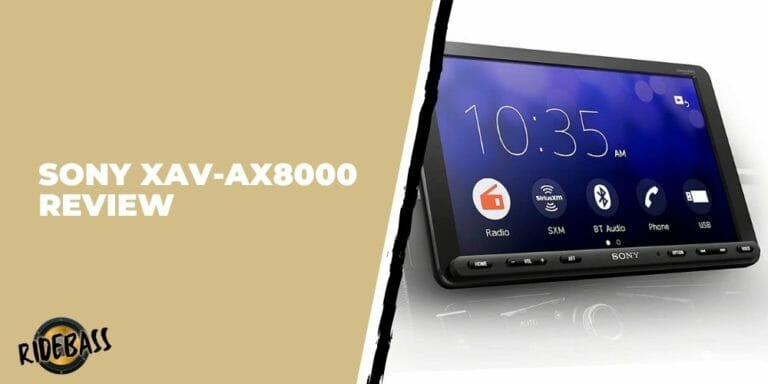

Sony XAV-AX8000 Review: A Big Floating Screen That Fits Where Nothing Else Does
The Sony XAV-AX8000 is the head unit to choose when you want a large screen but their dash only has a single-DIN slot to give up, and on that promise it delivers. Its whole reason to exist is that 8.95-inch floating display bolted to a slim 1-DIN chassis. The catch is that the rest of the unit is honest, mid-tier hardware from an older generation, so you buy it for the screen and the fit, not for cutting-edge connectivity.
Owner reports and independent reviews make it clear where the XAV-AX8000 shines and where it quietly shows its age. This review walks through the display, the CarPlay and Android Auto experience, the sound, and the install, then lines it up against newer floating units.
Sony XAV-AX8000 Specifications
These figures come from Sony’s published specs, cross-checked against independent reviews. Where a number is commonly misreported or not clearly documented, I flag it rather than guess.
| Spec | Detail |
|---|---|
| Display | 8.95-inch floating touchscreen, 800 x 480 resolution, TFT active matrix, 16:9 |
| Chassis / fit | Single-DIN (1-DIN) chassis; screen floats in front of the dash on an adjustable mount |
| Apple CarPlay | Wired only (no wireless CarPlay) |
| Android Auto | Wired only (no wireless Android Auto) |
| Preouts | 3 preouts (front, rear, subwoofer) |
| Power | 4 x 55W peak; approximately 4 x 20W RMS |
| Rear / backup camera | Rear-view camera input: yes (single camera input) |
| HDMI | None on this model (no HDMI input or output) |
| Bluetooth | Yes, hands-free calling and audio streaming (A2DP, AVRCP, HFP, PBAP). Exact Bluetooth version is not clearly documented by Sony, so treat any “5.0” claim as unconfirmed |
| Audio tuning | 10-band equalizer, Dynamic Stage Organizer, EXTRA BASS |
| Tuner | AM/FM with RDS |
| Dimensions (W x H x D) | Approximately 229 x 136 x 253 mm |
Two things on that table matter more than the rest, and I want them front and center: this unit is wired-only for CarPlay and Android Auto, and it has no HDMI. If you have seen the XAV-AX8000 grouped with wireless floating units, that grouping is wrong. Plan on running a cable.
The Screen: Why You Actually Buy This Unit
The display is the headline and it earns it. At 8.95 inches it is dramatically bigger than the four to seven inch faces you normally get in a single-DIN slot, and because it floats out in front of the dash rather than sitting recessed inside it, you get a nearly bezel-free panel in a car that was never designed to hold one. In an older sedan or truck with a factory single-DIN pocket, it feels like the whole dash was re-engineered around it. It was not. That is the trick.
Now the honest part. The panel is 800 x 480. Against today’s HD floating screens it looks soft, and fine text in maps or menus is not razor sharp. The touchscreen is responsive enough for daily driving, but it is not the glass-smooth capacitive feel of a modern flagship, so expect the occasional firmer press. Sony’s anti-glare coating genuinely helps in direct sun, which is more than I can say for some glossier competitors that turn into mirrors at noon.
The floating mount tilts and adjusts how far it stands off the dash. That adjustability is not a gimmick. It is what lets the screen clear climate vents, gauge clusters, and gear selectors in cars where a fixed-depth screen would foul something.
CarPlay and Android Auto: Solid, But Bring a Cable
Both Apple CarPlay and Android Auto are supported, and both run well once connected. Maps, messages, music, and voice all behave the way you expect, and the big screen genuinely improves CarPlay navigation because the map real estate is huge compared to a small factory head unit.
The limitation is the one I keep circling back to: it is wired. You plug your phone into the USB port every time. For a lot of drivers that is a non-issue, since a wired connection is stable and keeps the phone charged. But if you have gotten used to wireless CarPlay and just sitting down to drive, going back to a cable is a real step down. It is the single biggest reason someone cross-shops this unit against newer floating screens.
For Android users who do not want to keep a phone tethered, the unit also supports app mirroring through WebLink, which covers apps like Waze, Spotify, and others. It is not a replacement for Android Auto, but it is a useful fallback. iPhone users are effectively CarPlay-or-nothing here.
Sound: Clean Preouts and Enough Tuning to Matter
The XAV-AX8000 is better set up for a real system than its tier suggests, and that comes down to its three preouts: front, rear, and a dedicated subwoofer output. You can run external amplifiers to your door speakers and drive a sub without robbing the front stage. If you plan to add amplification later, that dedicated sub preout is the spec that saves you from an awkward workaround down the road.
On the internal amp, treat the 4 x 55W as a peak figure. The honest continuous number is around 4 x 20W RMS, fine for factory-replacement speakers at reasonable volume but short on headroom if you push it. My standard advice: use this unit as a source and preamp, and let outboard amps do the work. Its preouts are the reason it can anchor that kind of build.
Tuning is where Sony gives you more than expected. The 10-band equalizer is a genuine 10-band, not a token three-slider affair, so you have real control over how the system sits in the cabin. Dynamic Stage Organizer lifts the perceived soundstage toward the windshield, which helps offset low-mounted factory speakers, and EXTRA BASS is a one-touch low-end lift. It is a capable tuning suite for the money.
Two gaps worth naming honestly: there is no digital time alignment, which the tuning purists will miss, and video output options are limited, so this is not the unit for feeding external screens.
Installation: A Single-DIN Fit With a Floating Twist
This is the section that sells the unit to installers. The chassis is single-DIN, so it drops into the same slot a basic radio came out of. You are not cutting a double-DIN opening, you are not fabricating a dash kit for a larger cage. The body slides into the 1-DIN pocket and the big screen floats in front of the existing dash face.
That does two things. First, it makes this one of the only ways to get a nine-inch-class screen into a single-DIN car without butchering the dash. Second, the adjustable mount lets you dial in tilt and standoff depth to clear whatever the dash puts in the screen’s path.
A few field notes. Because the screen floats, mount rigidity matters more than on a recessed unit; a loose bracket shows up as screen shake on rough roads. Check that the floating panel does not obscure hazard lights or climate controls before you finalize the angle. And budget for the right harness adapter and, if the car has steering-wheel controls, the correct interface. If you are doing this yourself for the first time, our guide to installing a car stereo walks through the harness, ground, and antenna steps in order.
How It Compares
The XAV-AX8000 does not exist in a vacuum. If a big floating screen is what you are after, two other paths are worth weighing.
Sony XAV-AX8000 vs Pioneer DMH-WT7600NEX
The Pioneer DMH-WT7600NEX is the more modern floating unit and it out-specs the Sony on the two things the Sony lacks. It runs a 9-inch HD capacitive screen, and it supports wireless Apple CarPlay and Android Auto plus Amazon Alexa and HD Radio. If wireless phone integration and a sharper, glassier screen are what you want, the Pioneer is the newer answer and it will feel more current day to day.
Where the Sony still wins is fit and value. It is the more affordable way into a big single-DIN floating screen, and its adjustable mount depth clears obstructions in tight dashes. If a cable does not bother you, the Sony holds its ground. If you want the modern experience and can stretch, the Pioneer is the upgrade.
Sony XAV-AX8000 vs Kenwood Floating Units
Kenwood’s floating models push to a larger 10.1-inch screen and are often praised for a smooth, reliable interface. The trade-off is physical size: Kenwood’s units carry extra buttons and a volume knob on the panel, so the whole assembly is bigger than the Sony’s clean, control-light face and takes up more room in front of the dash. In a cramped cabin that difference is real, and it is exactly where the Sony’s slimmer panel wins. If maximum screen and a physical knob matter more than compactness, look at Kenwood; if you want the least intrusive big screen, the Sony is easier to place.
For the wider landscape of what fits which dash, our roundups of the best double-DIN CarPlay head units and the best single-DIN head units put the XAV-AX8000 in context against both form factors.
Pros and Cons
Pros
- Huge 8.95-inch floating screen in a single-DIN chassis, a fit almost nothing else offers
- Adjustable mount (tilt and depth) clears vents and controls in tight dashes
- Three preouts including a dedicated subwoofer output for real amplified builds
- Genuine 10-band EQ plus Dynamic Stage Organizer and EXTRA BASS
- Effective anti-glare coating that stays usable in direct sun
- Both Apple CarPlay and Android Auto supported, plus WebLink mirroring
Cons
- Wired-only CarPlay and Android Auto, no wireless
- 800 x 480 resolution looks soft next to modern HD floating screens
- No HDMI input or output
- Internal amp is modest (around 4 x 20W RMS); plan for external amps for serious sound
- No digital time alignment for advanced tuning
- Floating panel demands a rigid mount or it shakes on rough roads
Who Should Buy the Sony XAV-AX8000
Buy it if you drive an older or single-DIN vehicle, you want the biggest screen you can honestly fit without rebuilding the dash, and you are comfortable plugging in a cable for CarPlay or Android Auto. It is also a smart source unit if you are building an amplified system, because those three preouts and the 10-band EQ give you room to grow. For value-minded buyers who care about screen size and fit over having the newest features, it is an easy recommendation.
Who Should Skip It
Skip it if wireless CarPlay or Android Auto is a must-have, if you want a razor-sharp HD screen, or if you need HDMI for external video sources. In any of those cases the newer floating units from Pioneer or Kenwood are the better spend, even at a higher price. If you also want to understand which manufacturers tend to age well on software and support, our take on the best aftermarket car stereo brands is worth reading before you commit.
Frequently Asked Questions
Does the Sony XAV-AX8000 have wireless CarPlay or Android Auto?
No. Both Apple CarPlay and Android Auto on the XAV-AX8000 are wired only. You connect your phone to the USB port each time. If wireless is a requirement, this is not the right unit for you.
Will the XAV-AX8000 fit a single-DIN dash?
Yes. That is its defining feature. The chassis is single-DIN (1-DIN), so it installs in a standard single-DIN slot while the 8.95-inch screen floats out in front of the dash. It is one of the few ways to get a screen this large into a single-DIN car.
How many preouts does the XAV-AX8000 have?
Three: front, rear, and a dedicated subwoofer output. That lets you run external amplifiers for your speakers and drive a sub independently, which is why it works well as the source unit in an amplified system.
Does the XAV-AX8000 support a backup camera?
Yes. It has a rear-view camera input, so you can wire in a single backup camera that triggers when you shift into reverse. It does not offer multiple simultaneous camera inputs.
How much power does the XAV-AX8000 put out?
It is rated at 4 x 55W peak, which works out to roughly 4 x 20W RMS continuous. That is adequate for factory-replacement speakers at moderate volume. For higher output or better sound quality, use external amplifiers through the preouts.
Is the XAV-AX8000 still worth buying?
It is worth it if you specifically need a big screen in a single-DIN dash and do not need wireless phone connection or an HD panel. For that job it remains one of the few real options. If you want the newest features, a current floating unit will serve you better.
The Verdict
The Sony XAV-AX8000 is a focused tool, not an all-rounder. It solves one problem better than almost anything else on the market: getting a large, well-lit, adjustable floating screen into a car that only offers a single-DIN slot. Layer on three preouts and a real 10-band EQ and it becomes a legitimate foundation for an amplified build. Just go in with clear eyes about the wired-only CarPlay and Android Auto, the older-generation 800 x 480 panel, and the lack of HDMI. If those trade-offs fit your car and your priorities, this is a unit I am comfortable recommending. If they do not, spend up for a newer floating screen and do not look back.
About this guide
RideBass Team
Researched from manufacturer specifications, independent tests and owner reports, and edited for accuracy by the RideBass team.